PacingCarbs
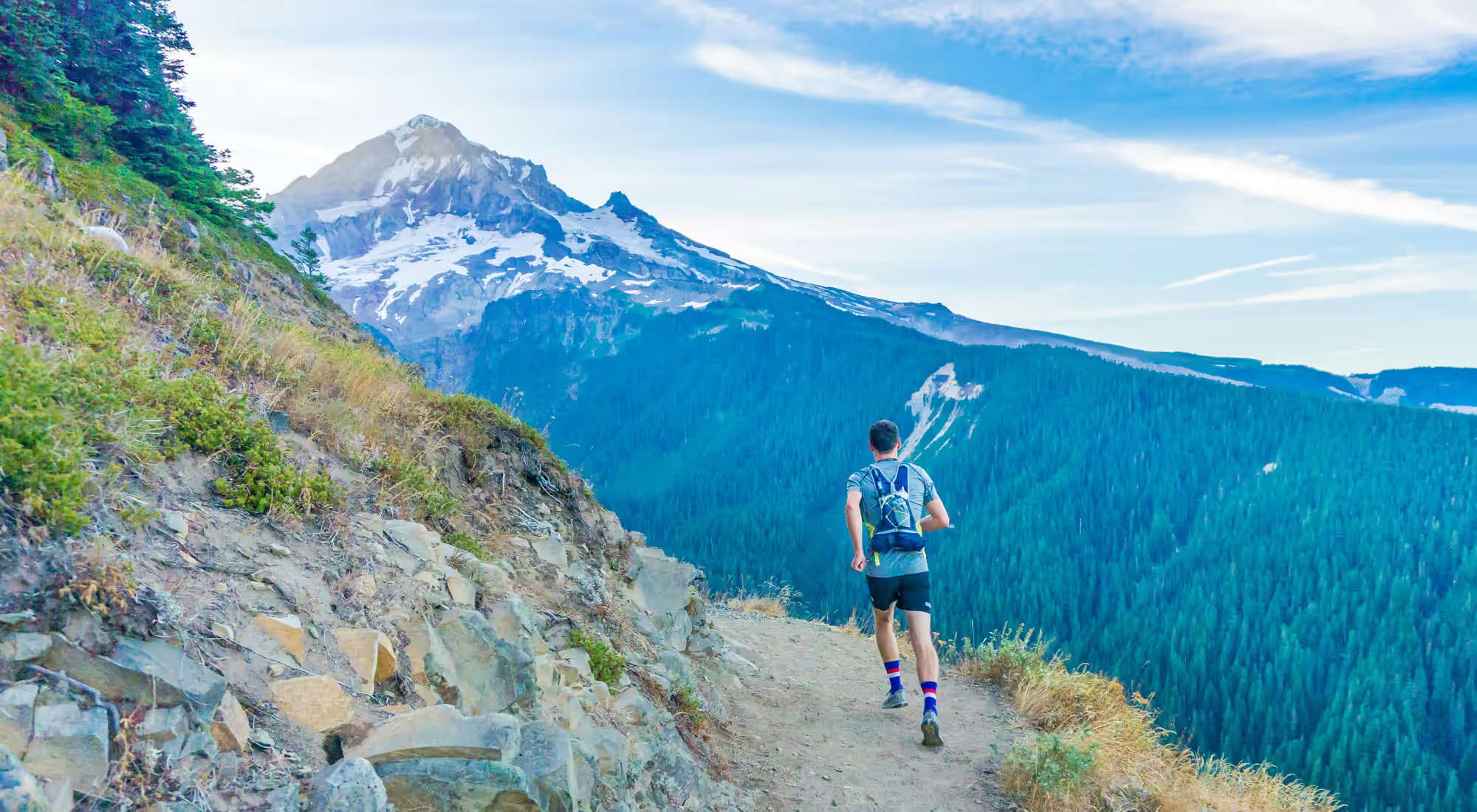
A runner on a ridge trail, a snow-covered mountain range in the distance.

Trail · Ultra · Running

Your trail running nutrition plan, built on real elevation

A constant carb target in g/h does not produce evenly spaced intakes in kilometres. Elevation shifts everything, and the plan does that maths.

TRAIL DE TEST 21 KM
04:30
TARGET TIME
1054m
ASCENT
65g/h
CARBS
27
INTAKES

Computed just now by the engine, on 21,0 km of real GPS track.

The elevation profile is the timeline

The terrain carries the fuelling points directly. Not a chart on one side and a list on the other.

174313609760510152000:06 — Eau (flasque 500 mL) — 100 mL00:08 — Maurten Drink Mix 320 (bidon 500 mL) — 100 mL00:22 — Maurten Gel 100 — 1 gel00:30 — Eau (flasque 500 mL) — 100 mL00:42 — Eau (flasque 500 mL) — 100 mL00:45 — Maurten Drink Mix 320 (bidon 500 mL) — 100 mL01:00 — Maurten Gel 100 — 1 gel01:06 — Eau (flasque 500 mL) — 100 mL01:18 — Eau (flasque 500 mL) — 100 mL01:23 — Maurten Drink Mix 320 (bidon 500 mL) — 100 mL01:38 — Maurten Gel 100 — 1 gel01:42 — Eau (flasque 500 mL) — 100 mL01:54 — Eau (flasque 500 mL) — 100 mL02:01 — Maurten Drink Mix 320 (bidon 500 mL) — 100 mL02:16 — Maurten Drink Mix 320 (bidon 500 mL) — 100 mL02:30 — Eau (flasque 500 mL) — 100 mL02:32 — Maurten Drink Mix 320 (bidon 500 mL) — 100 mL02:45 — Maurten Gel 100 — 1 gel02:54 — Eau (flasque 500 mL) — 100 mL03:06 — Eau (flasque 500 mL) — 100 mL03:08 — Maurten Drink Mix 320 (bidon 500 mL) — 100 mL03:23 — Maurten Drink Mix 320 (bidon 500 mL) — 100 mL03:38 — Maurten Gel 100 — 1 gel03:42 — Eau (flasque 500 mL) — 100 mL03:54 — Eau (flasque 500 mL) — 100 mL04:01 — Maurten Drink Mix 320 (bidon 500 mL) — 100 mL04:16 — Maurten Drink Mix 320 (bidon 500 mL) — 100 mL
Distance (km) · elevation (m)solid intakeliquid intake
0,5 km00:06Eau (flasque 500 mL)100 mL
0,7 km00:08Maurten Drink Mix 320 (bidon 500 mL)100 mL
2,0 km00:22Maurten Gel 1001 gel
2,6 km00:30Eau (flasque 500 mL)100 mL
3,4 km00:42Eau (flasque 500 mL)100 mL
3,5 km00:45Maurten Drink Mix 320 (bidon 500 mL)100 mL

Move the sliders

This is the production engine running on a fixed course. Change the target time or the carb rate and the plan recomputes.

Method

How a trail running nutrition plan is built

01

Your route, not an average

The GPX is split every 500 m. Each segment gets an effort coefficient derived from Minetti's work on the energy cost of running on a gradient. Your target time is spread in proportion to that cost: that is your race clock.
02

Two needs, two curves

Carbohydrate and fluid do not follow from one another. At 90 g/h, how much you drink varies twofold depending on the products. The engine tracks both targets and triggers an intake as soon as either one falls behind.

03

What you are actually carrying

You declare your gels, bars, bottles and refills. The plan sticks to them, tells you when each runs out, and refuses to promise an intake your pack cannot deliver.

How many carbs per hour when trail running?

The answer depends on how long you will be out there, not on the distance. Here are the usual ranges; the tool starts at 60 g/h and you move the slider wherever you want.

Under 2 h
30 to 60 g/h

Glycogen stores nearly cover it. Fuelling is mostly there to stop you fading at the end.

2 h to 4 h
60 to 90 g/h

The most common range in trail running. Above 60 g/h, mixing glucose and fructose starts to help absorption.

Over 4 h
70 to 100 g/h

On an ultra the limit stops being the requirement and becomes your stomach. Steady intakes go down better than large ones spread far apart.

What these ranges do not settle is when to take each gel, each sip, each bar. That is what the calculator does from your track. Need your finishing time first? The pace and split calculator is free and needs no account.

Same interval, twice the distance

On rolling terrain, sixteen minutes apart can mean twice the distance covered. That is exactly what a "gel every 5 km" plan cannot see.

WindowDurationDistancePace
04:03 → 04:1916 min1,5 km10:40 /km
05:43 → 05:5916 min3,3 km4:51 /km
PLAN EXTRACT
00:060,5 kmEau (flasque 500 mL)100 mL
00:080,7 kmMaurten Drink Mix 320 (bidon 500 mL)100 mL
00:222,0 kmMaurten Gel 1001 gel
00:302,6 kmEau (flasque 500 mL)100 mL
00:423,4 kmEau (flasque 500 mL)100 mL
00:453,5 kmMaurten Drink Mix 320 (bidon 500 mL)100 mL

Capabilities

What the planner does

Built on elevation

Uphill you eat every 1.5 km, downhill every 3.3 km, for the same time interval.

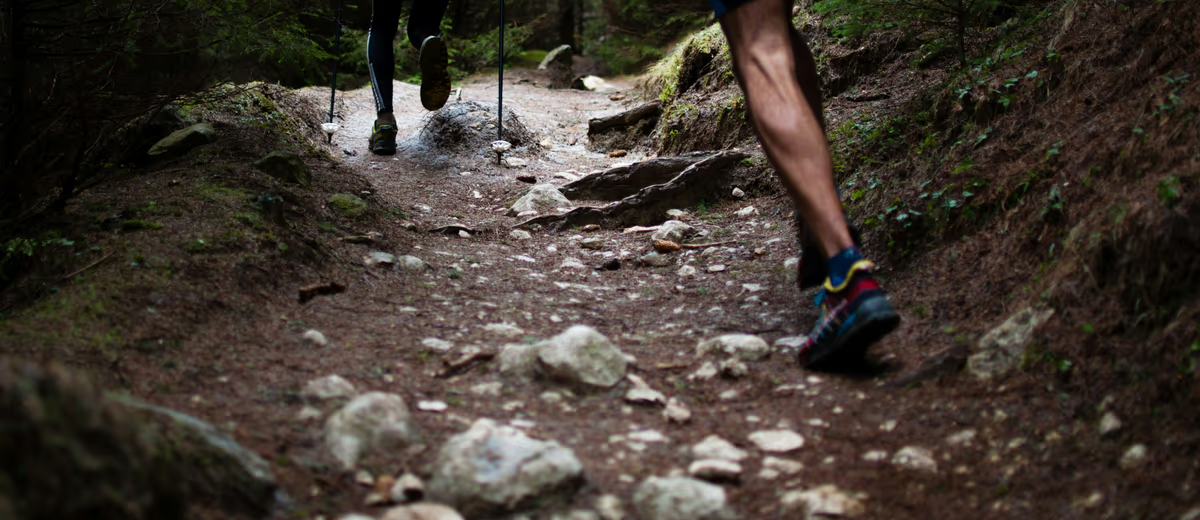
Two trail runners with poles on a steep climb through woodland.
1,5 km
uphill
3,3 km
downhill

Alerts on your watch

Export a GPX route with one waypoint per intake. The watch warns you as you approach.

.gpx

Real inventory

8 gels, 2 bars, 3 flask refills: the plan works with what you are carrying.

It says no when it is no

A drink at 6 g/100 mL tops out at 36 g/h. The plan says so instead of letting you believe otherwise.

OVER LIMITCOMPUTED

Hydration

A target in mL/h, independent of carbohydrate, with water as a product in its own right.

Your products, not ours

Pick your gels, bars and drinks by brand from the built-in catalogue, or add your own by hand. The plan works with what you actually eat, and respects the order of preference you set.

Built-in catalogue
13 products · 3 brands
  • Maurten
  • Nduranz
  • Overstim's

Or enter your own: name, carbohydrate, volume. They are saved to your account and offered on every new race.

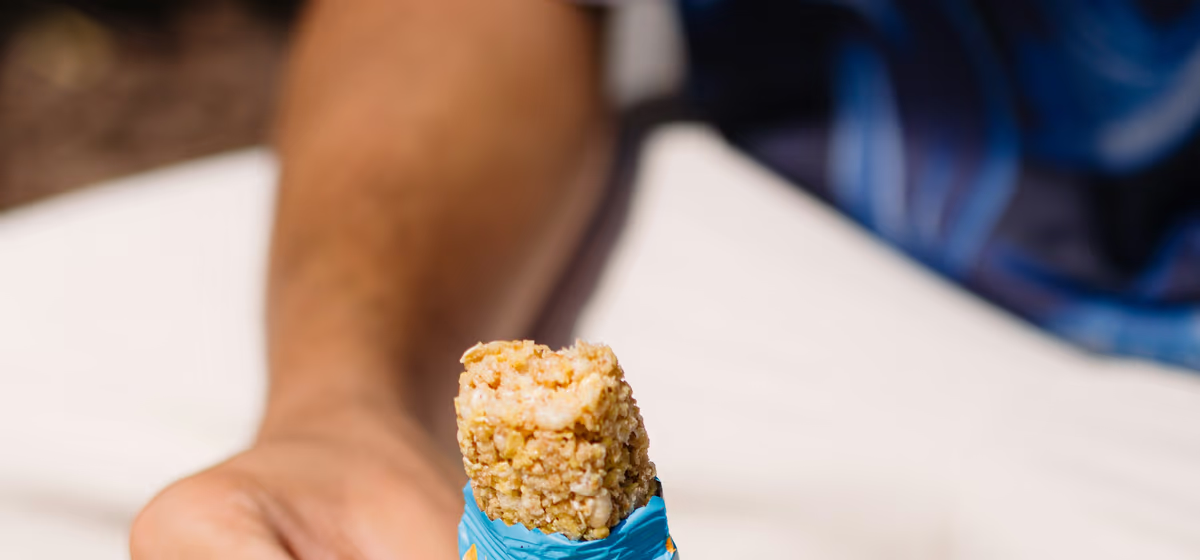
Two hands opening a cereal bar during a break.

Feedback

What runners say

Already more than 50 plans generated, on the real track of each race.

I love being able to load the GPX alerts straight onto my watch, so it warns me during the race.

Maud · PacingCarbs user

I like that I can add my own nutrition brand on top of the products already in the tool.

Théo · PacingCarbs user

One race free to try

Full plan and watch export included, no card required.

Single race

2,90 €per plan

For a one-off goal, no commitment.

5-race pack

9,90 €for 5 plans

Five plans in reserve, no subscription, no expiry.

Le plus complet

Season

19,90 €per year

Unlimited for a year, built around your race calendar.

Frequently asked questions

›How many carbs per hour when trail running?

Between 30 and 60 g/h for under two hours, 60 to 90 g/h on a trail run of 2 to 4 h, and up to 90 to 100 g/h on an ultra if your stomach tolerates it. Above 60 g/h a glucose-fructose blend absorbs better than a single sugar. These ranges are a starting point: the tool's slider begins at 60 g/h, and the real question, the one the plan answers, is at what minute and what kilometre to place each intake.

›How much should you drink per hour when trail running?

The usual guide is 400 to 800 mL per hour, adjusted for heat and how much you sweat. Volume does not follow from carbohydrate: at 90 g/h, whether you run on gels and water or on a concentrated drink changes how much you drink twofold. That is why the tool treats hydration as a separate target in mL/h and triggers a sip as soon as the curve falls behind.

›What should you eat on a 30, 50 or 100 km trail race?

Distance matters less than time on your feet: it is your hours of effort that set the total to take in. On a hilly 30 km in 4 h at 75 g/h you need around 300 g of carbohydrate, roughly ten gels or the equivalent in drink and bars. The tool does that calculation from your GPX and your target time, then checks that what you are actually carrying covers it.

›Where does the effort model come from?

From the energy-cost polynomials of Minetti et al. (2002), which measure the cost of running and walking by gradient. Three corrections are applied to match the reality of trail running: the saving from running downhill is only partly converted into speed, braking costs you beyond −10 %, and the model switches to power hiking on steep gradients. The constants are documented and adjustable.

›Do the watch alerts follow the clock or the distance?

The distance. The waypoint is placed at the kilometre computed for that intake. As long as you hold your target time the two coincide; if you drift, the alerts follow the course, which is the right behaviour for fuelling.

›Which watches are supported?

Any watch that can import a GPX route with waypoints. The import instructions provided target the Suunto app. Waypoint syncing is reported as more reliable on Android: worth checking on your own setup before race day.

›What about cycling and triathlon?

Not yet. The current engine models running; on a bike, speed depends on power, aerodynamics and rolling resistance, which needs a different model. We would rather say so than sell you an approximate calculation. Leave your address on the relevant page to be notified.

›Can I cancel?

The Season plan is an annual subscription, cancellable at any time from your account; it stays active until the end of the paid period. Plans bought individually are credits with no expiry.

Your next race deserves better

Five minutes for a plan you will carry on your watch.

Plan my race

No card required. Watch export included on the free plan.